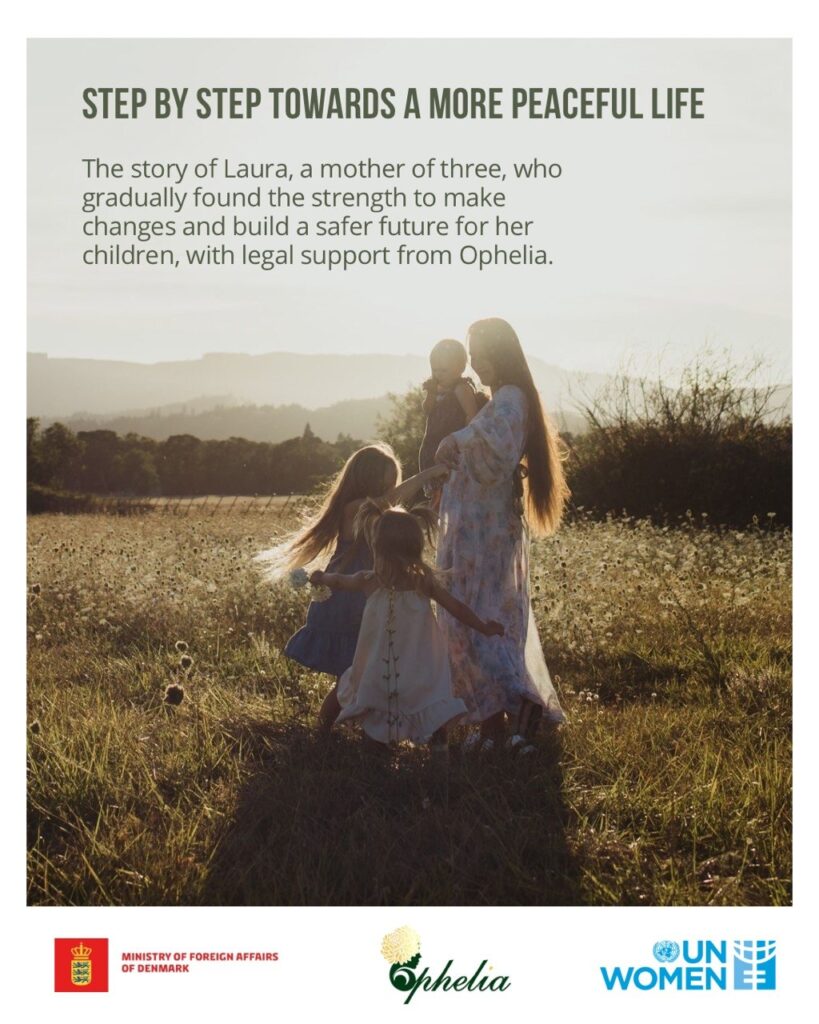
Laura (name changed) is a mother of three. Having grown up in a village, she is used to working hard and putting her heart into everything she does. Whether it involves household chores, fieldwork or caring for animals, Laura is willing to learn, try new things and do whatever is necessary to provide for her children and create an environment where they feel safe.
Laura’s first marriage ended following episodes of physical violence and legal proceedings. Her eldest daughter, Ana (name changed), was born from this relationship.
Some time later, Laura entered a new relationship. She wanted her eldest daughter to grow up in a complete family and hoped to build such a family with her new partner. He told her that he would treat her daughter well, and Laura believed him. The two got married and, over the following two years, had two more children.
Over time, tensions and conflicts within the family became increasingly frequent, affecting not only the relationship between the spouses but also the children’s emotional well-being.
Throughout these years, Laura took on most of the family responsibilities. She also had to pay rent for the house where they lived. Her husband worked only for short periods, sometimes just a few days, after which he could stay at home for weeks or even months. Laura worked to provide for the family and, after work, took care of the household and the children.
“He could work for a few days and then stay at home for a week or even the entire winter. But who was going to provide for the children or pay the rent?” Laura recalls.
In addition to her husband’s lack of involvement in supporting the family, his alcohol consumption made the situation worse. When he drank, he became more aggressive and started arguments that sometimes lasted until the middle of the night. He made noise and would not let the children sleep. On some occasions, Laura had to call the police, but the interventions usually ended with a warning or a fine.
When Laura tried to talk about what was happening within the family, she did not always find understanding. At one point, she told her mother-in-law that the situation could no longer continue this way. Her response was: “How did people live in the past? They endured it and kept quiet. And now…”
At times, Laura heard similar remarks from other people in the village.
“If you spoke less, everything would be fine. You saw that he had been drinking, so you should keep quiet,” she recalls.
During that period, the Ophelia Centre was organising information and support sessions in the village where Laura lived, and she attended every meeting.
“I would leave everything behind and go. When I was at those meetings, I felt so peaceful,” Laura remembers.
Through these meetings, she learned more about women’s rights and the opportunities available to her to seek help.
Later, Laura contacted the person who had organised the sessions, who put her in touch with a lawyer from AO Ophelia. The lawyer provided legal consultations and represented her in court during the divorce proceedings and the process of determining parental rights and responsibilities. As a result of the legal proceedings, Laura obtained a divorce, the determination of the children’s place of residence and child maintenance payments.
The decision to leave did not come all at once. Gradually, Laura realised that if nothing changed, she and her children would continue living under the same conditions. She wanted to leave together with them and provide them with a place where they could feel safe.
She also needed somewhere to live after the separation. Her brother was living in their parents’ house, so Laura spoke to him about the possibility of moving there with her three children until she could afford to rent another home.
Today, Laura lives with her children in the family home, together with her brother and his family. The children’s father sees them based on an agreement between the parents.
“The children are safe now. I no longer live in fear that someone will come and start shouting. Now we live in peace and quiet. I have always been both a mother and a father to my children. I raised them on my own. But now things are more peaceful,” Laura says.
Looking at the people around her, Laura says she still sees women going through similar situations who find it difficult to make a change. However, she encourages them not to continue putting up with disrespect and abuse, but to seek help.
“No one but you has the right to decide what you should do in a particular situation, especially when violence is involved. Every one of us deserves to live a life of peace and dignity, and today there are so many organisations where you can find support,” Laura says in closing.
Her experience shows how important it is for women to have access to information, support and legal assistance when they need it. Sometimes, the first step is simply finding out that help is available and that they do not have to find a solution on their own.
How We Supported Laura
The free legal assistance provided by the Ophelia Centre, including legal consultations and court representation, is delivered as part of the project “Enhancing Women’s Leadership for Resilient and Peaceful Societies”, funded by the Government of Denmark and implemented by UN Women Moldova, in partnership with three organisations specialising in the protection of women’s rights, including the Ophelia Centre.
We Can Help You Too
If you are experiencing violence, call the Ophelia Centre’s Helpline at +373 79 12 00 12 or the Women and Girls’ Trust Line at 0 8008 8008 to receive consultations and referrals to free and confidential support services. In case of immediate danger, call 112.