Before getting married and becoming a mother of three children, Elena (name changed) led an active life. She worked, was financially independent, and made time for sports, walks and friends. She never imagined that, a few years later, her biggest concern would be how to provide everything her children needed.
After the birth of her first child, she took parental leave and became financially dependent on her husband. His income was unstable, and with the arrival of their second child, the family’s situation became even more difficult.
When their second child was only a few months old, the couple divorced. “There were many reasons that led to this decision. It was a very difficult period for me. I felt that I was left alone to deal with responsibilities that we should have shared as a family.”
The court established a minimum child support payment, but it did not cover the children’s everyday expenses, and Elena continued to bear most of the financial and caregiving responsibilities.
After some time, Elena and her former husband decided to try again to be a family. Elena hoped that things would change and that they would be able to rebuild their relationship differently, for the sake of their children. During this period, their third child was born.
“I wanted to believe that we could start over and that, this time, we would share responsibilities as a family. Unfortunately, the change I was hoping for never came.”
The every day worries and responsibility for raising the children, however, remained largely on Elena’s shoulders.
She wanted to return to work, but for that she needed her husband’s support. “I asked him to stay with the children at least a few times a week so that I could go to work. I wanted to contribute to the family’s expenses and not depend entirely on him.”
Shortly afterwards, her husband went abroad to work, leaving Elena alone with their three children. “He said he was going abroad to earn money for the family. In reality, however, the financial support was unpredictable. Every time, I had to insist and explain why the children needed certain things. I felt that the entire responsibility for their needs remained on my shoulders, and sometimes I had to borrow money from people I knew to cover urgent expenses.”
There were times when even urgent expenses could not be covered. “When the children got sick, I would call him and tell him that we needed money for medicine. He would say that he understood and that he would send money in a few weeks, when he received his salary.”
That was when Elena realized that she could no longer wait for the situation to change on its own. “I realized that I had to start relying on myself. I got a job, found a babysitter for the children, and half of my salary went towards paying for childcare. It was difficult, but at least I felt that I was doing something to move forward.”
For Elena, this marked the beginning of an important change. She gradually began to move away from financial dependence and regain her autonomy. She also came to understand that the responsibility for raising and providing for the children should be shared fairly between both parents.
This realization prompted her to take the next step: seeking legal support to ensure that the children’s right to financial support was established in accordance with the law, rather than depending on promises or informal arrangements between the two parents.
In search of a solution, Elena reached out to the AO Ophelia team.
Discussions with the Centre’s specialists helped her understand that what she had been experiencing was not simply a financial difficulty, but a situation in which the lack of consistent support and dependence on the other parent’s decisions were affecting her sense of security and autonomy.
With the support of AO Ophelia, Elena received free legal assistance and legal representation in court. Throughout the process, a lawyer helped her defend her rights and obtain a formal child support order. The court ruled that child support should be paid as a percentage of the father’s income. The legal process is currently continuing to establish a fixed amount that would provide the children with more stable and predictable financial support.
For Elena, however, the changes did not stop with the court decision.
After the separation, she noticed that her children’s relationship with their father had also changed. He began spending more time with them and becoming more present in their lives. “When we lived together as a family, the children’s father was everywhere except at home.”
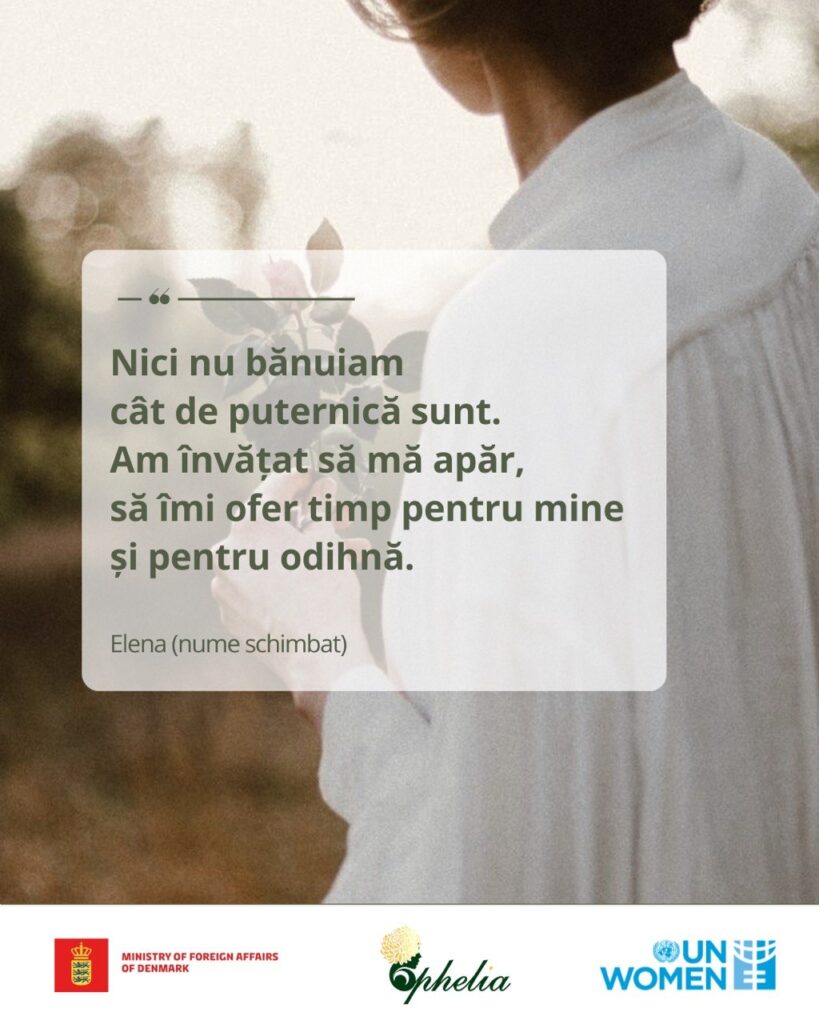
At the same time, Elena began to change as well. “The changes have been enormous. With the help of the psychologist at the Ophelia Centre, I learned to set personal boundaries. I learned to say ‘no’, to stand up for myself and to make time for myself and for rest without feeling guilty.”
For a long time, she believed that all the difficulties she was facing meant that she was not a good enough mother. Today, she looks back on that period differently. “Before I came to the Centre, I was convinced that I was a bad mother. Now I understand that a mother who is angry or exhausted is not a bad mother. She is a woman carrying too much on her shoulders and who needs support.”
Today, Elena looks to the future with greater confidence. She knows that she is stronger than she thought and that she has the right to make decisions that protect both herself and her children.
Her story shows that sometimes the first step is not to find all the answers, but to ask for help. And when a woman receives the right support, she can regain her confidence, stand up for her rights and build a safer future for her children.
How we were able to support Elena
The free legal assistance provided by AO Ophelia, including legal consultations and representation in court, is offered within the project “Strengthening Women’s Leadership for Resilient and Peaceful Societies,” funded by the Government of Denmark and implemented by UN Women Moldova in partnership with three organizations specializing in the protection of women’s rights, including AO Ophelia.
Since the launch of the project to date, 23 beneficiaries of AO Ophelia have received free legal assistance and support in cases involving child support, divorce, determining children’s residence, and obtaining protection orders.
We can help you
If you are experiencing violence, call the AO Ophelia Helplineat +373 79 12 00 12 or the Women and Girls’ Trust Line at 0 8008 8008 to receive consultations and referrals to free and confidential support services. In case of danger, call 112.